
Replaceable battery
No charging, no cable, no downtime. Swap the cell and carry on. Suited to sites where equipment is shared across shifts or charging is impractical.
Hand protection
The glove that warns you first.
Three non-contact sensors in the thumb, index and middle fingers. A three-bar indicator on the back of the hand and a tone that rises with the field. OHMA warns you that a live AC conductor is close, before your hand reaches it.
Request a quoteA supplementary warning device. Always test with a rated instrument and follow your isolation procedure.
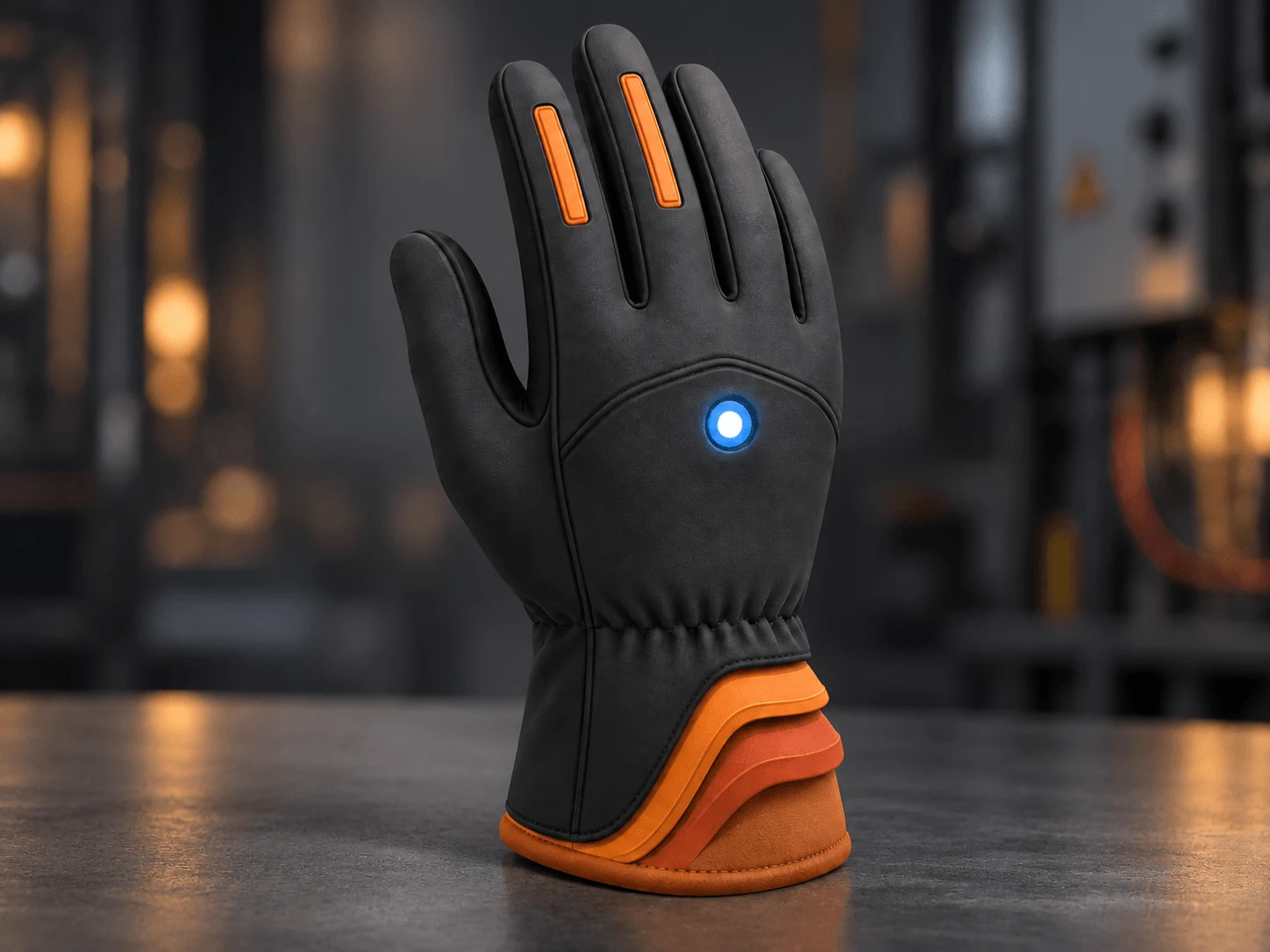
The wire you did not expect. The circuit someone else labelled. The conduit that should have been dead. Most electrical incidents do not begin with a mistake in judgement, they begin with an assumption about a conductor nobody had a reason to doubt.
OHMA does not remove the need to check. It gives you one more chance to notice before your hand arrives.
How it works

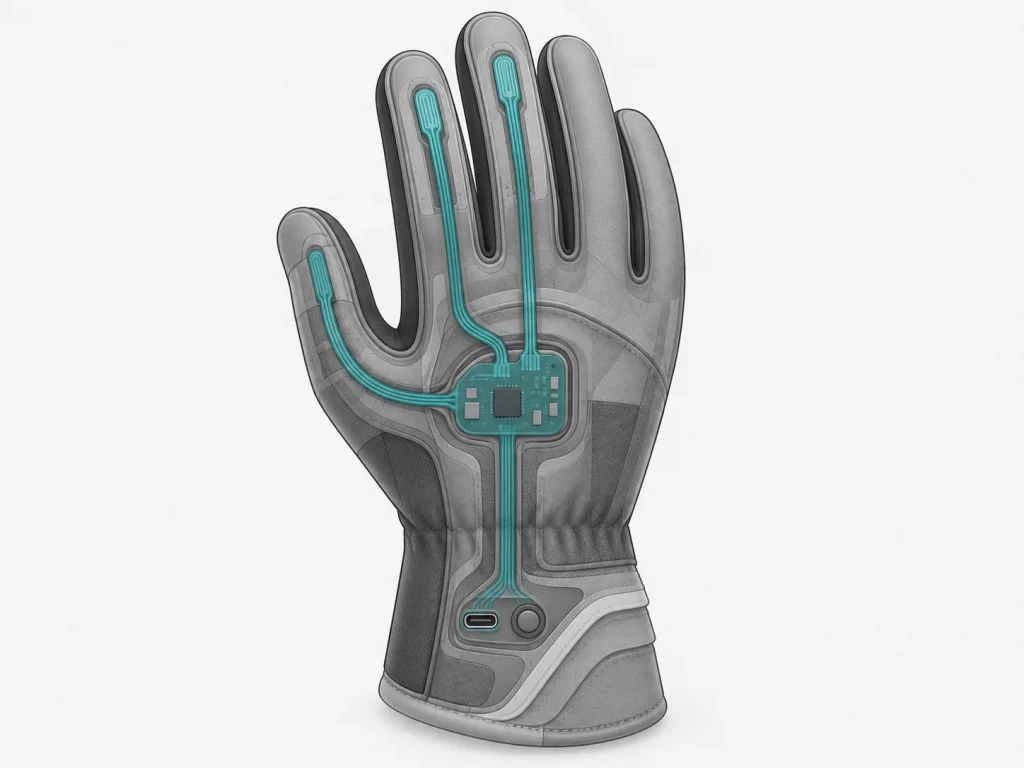
Flexible sensors run to the thumb, index and middle fingertips. Each one works independently, so the warning follows whichever finger reaches first.

OHMA responds to the alternating electric field around an energised conductor at 50 and 60 Hz. Nothing needs to be touched for the glove to react.

A three-bar indicator on the back of the hand moves from white to amber to red as the detected field strengthens, with a matching tone that shortens its interval and then holds.

If a sensor fails, the glove says so rather than staying quiet. A fault state and a low battery each have their own distinct pattern.
| State | Bars | Sound | Reading |
|---|---|---|---|
| Below threshold | None lit | Silent | No AC field detected above the warning threshold. This is not confirmation that a conductor is dead. |
| Low | One, white | Intermittent, slow | An AC field is present. Something nearby is energised. |
| Medium | Two, amber | Intermittent, faster | The field is stronger. You are closer, or the source is larger. |
| High | Three, red | Continuous tone | Strong field. Stop and reassess before moving your hand further. |
The glove reports the strongest reading from any working sensor, so a warning from one fingertip is enough. Levels indicate relative field strength, not voltage. Field strength depends on distance, orientation and the geometry of the conductor as well as the voltage on it.
| State | Indicator | Meaning |
|---|---|---|
| Sensor fault | All three bars red, one blink every few seconds | One or two sensors have failed. The remaining sensors keep working, and the glove keeps warning you, but it is telling you to have it checked. |
| System fault | All three bars red, three blinks every few seconds | No sensor is working. The glove cannot warn you. Remove it from service. |
| Low battery | All three bars amber, slow blink | Charge or replace the battery. Warning function continues until the battery is exhausted. |
A warning device that fails quietly is worse than no warning device at all. OHMA is built to tell you when it has stopped being useful.
The electronics sit between the layers of the glove. A single compact assembly on the back of the hand, three flexible sensing paths running to the fingertips, and the power controls set at the wrist, away from the work.
The sensing paths are flexible throughout. The thumb route is shaped to follow the thumb’s own movement rather than fighting it, so the glove grips and closes normally. There is nothing rigid at the fingertips and nothing to snag.
No charging, no cable, no downtime. Swap the cell and carry on. Suited to sites where equipment is shared across shifts or charging is impractical.
Charges by USB Type-C at the wrist. Sensing is disabled while charging, and the glove tells you when it is running low. Suited to individual issue and regular daily use.
Detailed technical specifications, test conditions and performance limits are available on request. Tell us the application and we will send the documentation your team needs.
Request specificationsTell us the application, the quantities and the sizes you need. We will come back with pricing, lead time and the technical documentation your team needs to evaluate it.

Protective equipment that senses.
OHMA is a supplementary warning device. It is not a substitute for approved voltage-testing instruments, isolation procedures or personal protective equipment. Always follow your organisation’s electrical safety procedures.
© 2026 Eve Shields. All rights reserved.