
A small team working across four disciplines that rarely sit in the same room.
A sensing glove is an awkward thing to build because it belongs to several fields at once and sits comfortably in none of them. It is protective equipment, so it answers to the standards and the wear expectations that govern PPE. It is a precision analogue instrument, operating at signal levels where the human body itself is the largest source of interference. It is a flexible electronic assembly that has to survive being bent thousands of times by a working hand. And it is a piece of safety equipment whose interface has to be understood correctly by someone who is tired, in poor light, and thinking about something else.
Our team is organised around those four problems.
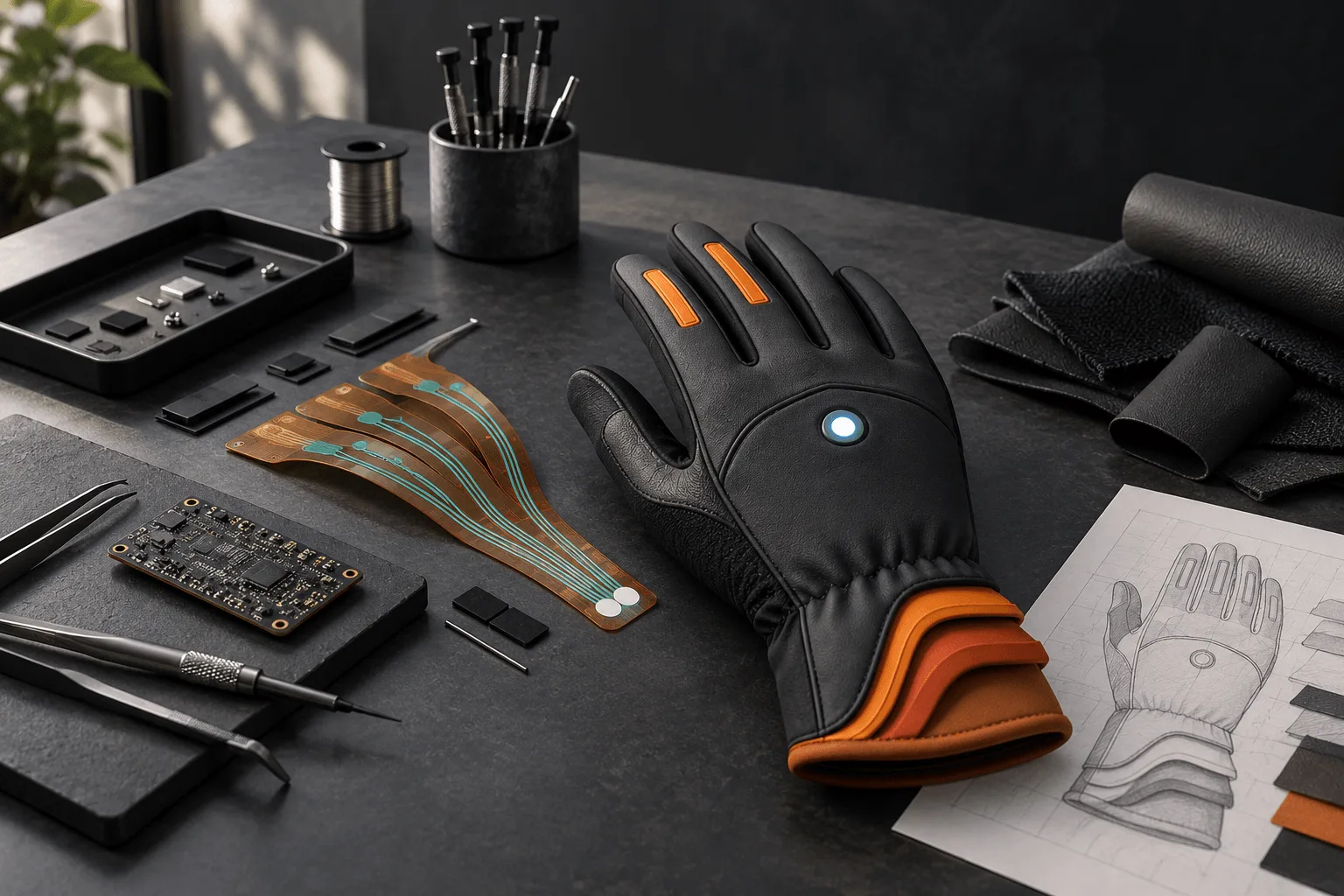
Front-end design, interference rejection and the signal processing that turns a weak field into a reading that holds steady while a hand is moving.
Flexible circuit design, materials and bend-life engineering, so the sensing paths survive the life of the glove rather than the life of a demonstration.
Detection thresholds, fault detection and the state logic that decides what the glove shows, including what it shows when part of it has failed.
Glove construction, fit, and the integration of electronics into something a person will actually keep wearing for a full shift.
We work as one team rather than as separate functions handing work along. The people who design the sensing decide the construction with the people who make it, because in a product this size the two cannot be separated.
We also work with specialists outside the company where that is the right call: certification, testing, materials and manufacturing. We would rather bring in someone who has done a thing many times than learn it slowly at a customer’s expense.
Tell us about the application and the quantities, and we will come back with pricing, availability and the technical detail your team needs.

Protective equipment that senses.
OHMA is a supplementary warning device. It is not a substitute for approved voltage-testing instruments, isolation procedures or personal protective equipment. Always follow your organisation’s electrical safety procedures.
© 2026 Eve Shields. All rights reserved.